 Video on Patreon
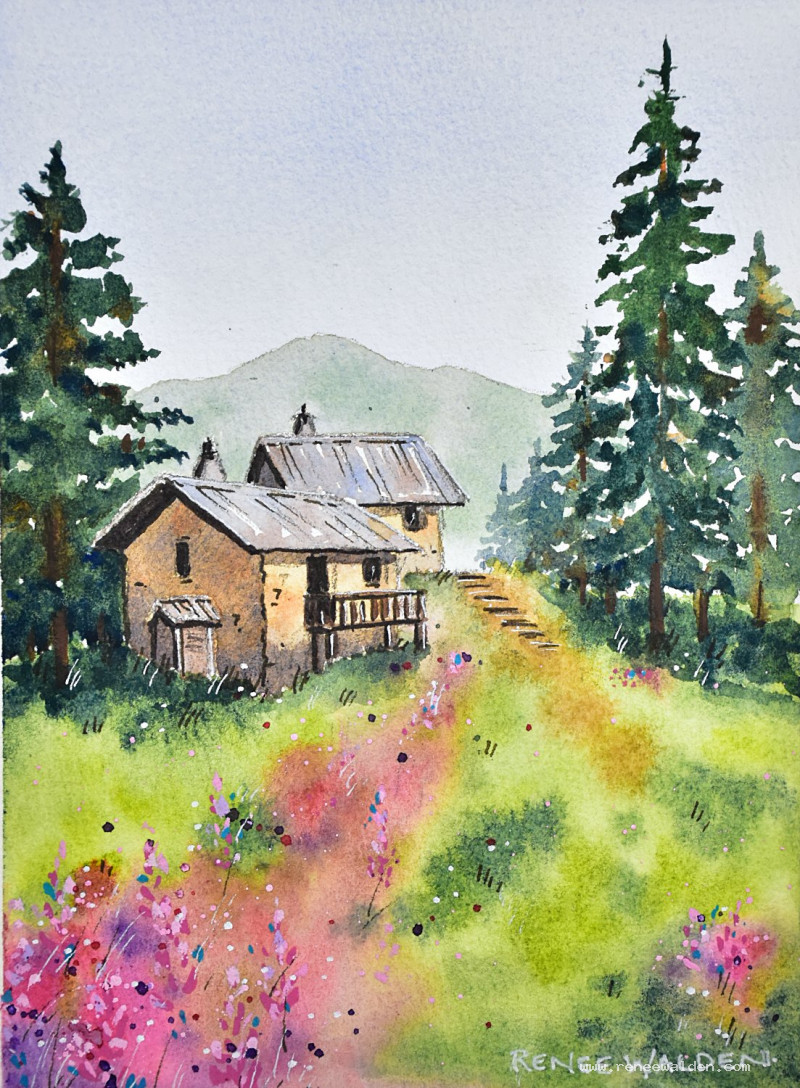
Cabins in Chamonix
1 October 2026
Video - Level ◆◆◆
On a rainy day walk in Chamonix in August we stumbled upon these little stone cabins in a forest. I didn't have my sketching stuff with me because of the weather, but I took lots and lots of photos.
I've since used these photos to do a few little paintings of the place, and some people have asked if I'd redo one as a lesson. Of course! If you ever see something I post online that you'd like as a lesson, just let me know. I'm always happy to add requests to my list.
Happy painting!
Video run-through...
About This Painting
A scene from a rainy day walk in Chamonix — isolated forest huts tucked among pine trees, with a sweep of pink flowers leading the eye toward the buildings. This is a lesson in composing with a lead-in line, painting a wet foreground all at once for soft blended edges, and choosing focal points that justify extra detail. The little outhouse and veranda get attention, but the flowers are the real star.
A traceable drawing is available in the lesson description.
The Pencil Drawing
Place the huts to one side — they're the focal point, so give them room and add detail: stonework, an outhouse, a little veranda. Keep the area in front of the buildings clear; that's where the flowers will sweep in. Indicate five or six conifer trunks without drawing their full shapes, add a hint of mountain behind, and mark the outhouse and veranda positions. Move any chimneys for better visibility — Renée opted for two even though the reference had one.
Colours to Prepare
- Cobalt blue — for the sky, mixed pale with a touch of brown to grey it down
- Quinacridone sienna — for warming the sky mix, stonework base, and pathway
- Sap green — main foliage colour throughout
- Green gold — warm, yellowy green for the foreground
- French ultramarine — shadow mixes and depth in the trees
- Sepia — dark browns for tree trunks, wood, and pathway
- Quinacridone rose — the main flower pink
- Permanent violet — second flower colour
- Natural sienna — stonework and warm tones
- White gouache — for opaque flower layers and splattering
Sky
Wet the entire sky area, painting straight over the mountain shape so it picks up a blue undertone — perfect for a rainy-day atmosphere and for making it read as distant. Add a flat wash of pale cobalt blue with a touch of quinacridone sienna to grey it down slightly (test it first — some blue-brown combinations go green). Work from the top down in single strokes and let the paint run out naturally toward the bottom, creating a soft gradation from darker at the top to nearly white at the horizon. Let dry, then hair dryer.
Mountain
While the sky wash is completely dry, mix the leftover bluey-grey with a little sap green for a pale bluish-green. Paint the hillside behind the buildings, giving it a pleasing shape. Where the hill meets the tree line, wet your brush, blot it slightly on the paper towel, and soften the edge so there's no hard line to paint around later. While still wet, drop in a touch of thicker green mix to suggest soft distant trees — just a hint of texture. This area should stay very simple; there's a lot happening in the foreground. Let dry.
Foreground: Wet the Whole Area
Before mixing any foreground colours, wet the entire foreground in one go with a flat brush — flowers, grass, pathway, shadow areas, everything. This gives you time to work slowly and creates beautiful soft edges throughout. If the paper is warm from the hair dryer, it may dry quickly, so keep an eye on it and re-wet if needed. You want a sheen but no puddles.
Foreground Colours to Prepare
Have two brushes ready — one for pinks, one for greens:
- Pink brush: quinacridone rose plus a little permanent violet (choose more than one flower colour so the sweep isn't flat)
- Green brush: sap green alone, and sap green plus green gold for warmer yellowy greens; French ultramarine plus sap green for shadow areas
- Pathway: natural sienna with a touch of sepia
Flowers
Working into the wet paper, lay in the sweep of pink from the foreground, making it wide at the bottom and tapering as it rises toward the buildings. Use bigger marks in the foreground where you're "standing in" the flowers, and smaller marks toward the back. Leave some white gaps — they add sparkle. Add the second colour (violet) while the first is still wet for natural variation. Fine to lift colour with a paper towel tip if something goes wrong; the wet paper keeps everything moveable for a while.
Greens and Shadows
Without waiting, switch to the green brush and lay in sap green close to the flowers but not quite touching — the water will carry the colour close enough without muddying into the pink. Use green gold for warmer areas. Bring in French ultramarine plus sap green for the shadow areas: under the trees, and to the side of the buildings where a cast shadow falls. Keep the greens moving and varied. Work the pathway in with natural sienna and sepia. Add extra darks in the corners to ground the painting.
Continue working while everything is wet — as long as the paint is moving, you can keep going. When it stops moving, stop too.
Buildings: Roofs
Once the foreground is completely dry, move to the buildings. Paint the roofs first using cobalt blue greyed down with a little quinacridone sienna — more blue than brown this time, so it reads as a bluish-grey metal. Paint in the direction of the corrugations (fan-shaped strokes), leaving occasional white gaps for shine. Drop in a little sepia and extra blue while still wet for variation. Do both roofs together; they can bleed slightly into each other — pen will separate them later. Add the chimneys. Let dry.
Buildings: Stonework
Cover the whole stone building in natural sienna as a base wash. While still wet, drop in quinacridone sienna, sepia, and a touch of the roof grey — let them bleed and merge to suggest the texture of stone without painting individual stones. A touch darker at the base helps the building look grounded. At this scale, this impression is enough; if you're painting much larger, you can suggest individual stones.
The outhouse is wood, not stone — paint it with plain sepia (or burnt umber) to distinguish the material. Keep it quieter than the main building so it doesn't steal attention. Use the same colour for the veranda.
Let everything dry thoroughly before the next step.
Buildings: Shadow Sides
Mix French ultramarine and quinacridone sienna for a warm-leaning shadow colour — quite diluted, since it's a rainy day with soft shadows rather than strong sun. Apply to the left-hand sides of the buildings, underneath the eaves, and inside the doorway and window openings. Work in clean passes; the wash underneath should still show through. Soften the shadow under the veranda by dragging a clean damp brush along the lower edge. Join all the shadow areas together — this gives the buildings their three-dimensional form. Let dry.
Trees
Prepare two dark greens and a brown:
- French ultramarine plus sap green = bluish-green, dark
- Sap green plus sepia plus a little blue = brownish-green, dark
- Quinacridone sienna = brown for pine cones and trunks
Use a large brush loaded with green for the bulk of each tree, holding the brush toward the back for a looser grip. Dance the tip across the page for a shaggy, irregular silhouette — not too tidy. While still wet, switch to a smaller brush to tease out a little detail. The French ultramarine will granulate beautifully and add texture on its own. Drop in the brownish-green and a few touches of brown for interest. Go dark along the bottom and the shadow (left) side.
For the tree nearest the focal point, spend more time and add water drops for blooms at the damp stage. Background trees should be paler and simpler — a couple of very pale, soft shapes at the back, with increasing detail and saturation as you come forward.
Darkest Darks and Building Details
With the trees in place, you can now judge how dark the building details should be. Mix French ultramarine and quinacridone sienna quite thick for near-black. Paint inside the windows, doors, and deep shadow under the eaves. A little negative painting in the grass alongside the veranda suggests stems. Add the steps.
If you're painting large, this is the moment to suggest a few individual stones with the brush. At smaller sizes, leave it — it gets fussy fast.
Shadows Under the Trees
Step back and check whether the tree trunks look grounded. If they appear to float, lay in a bluish-green shadow wash at the base of the forest to anchor them. Do the same under the veranda if it needs it.
Flower Details with Gouache
To sharpen the foreground flowers without muddying the transparent washes underneath, make an opaque pink: squeeze a little white gouache into a puddle of quinacridone rose. You now have a light-proof pink that can go over anything.
Dot and dash individual flowers in the foreground — bigger and more detailed close up, smaller and sparser toward the back. Use a second, lighter mix (more gouache, less pigment) for paler blooms. Add a few purple ones for variety. Splatter with the dark pink and the light pink to bring in some random natural energy. Finish with an entirely different colour — cobalt teal or lavender — in very small amounts. It shouldn't read as turquoise flowers; it should just add a little unexpected life among the pinks.
Pen Work and Final Details
Dark brown fountain pen ink for the shadow sides of the buildings: left edges, underneath the eaves, window reveals, the veranda struts. Keep the marks characterful rather than mechanical — slight wobbles are fine and appropriate for a stone building. Tease a few pen marks out into the trees and grasses so the pen doesn't look isolated in the buildings only.
White gel pen for anything catching the light on the right-hand side and along roof ridges. A few fine grass lines and small dots for sparkle.
Remove the tape.
Resources...
* Reference photo
* Drawing to trace
Join me on Patreon
Join my Adventures in Colour Tier for $16 to access this post and my full library of over 200 others including deep-dive videos and step-by-steps.